Mongolia tours with free WiFi during your trip – leave it to a local specialist travel company.

Contact us for advice and quotes on local Mongolia toursEmail:info@nomadmongolia.com

Mongolia's Central Gobi, Dundgovi Province




The Ongi River flows in the west, the land is covered with steppe vegetation, and the south is covered with desert. Dundgovi Province also holds underground resources such as copper, coal and iron ore, and gemstones such as marble, nephrite, jade and fluorite.
The province offers beautiful scenery, Ikh Gazriin Chuluu (large land stones) and Baga Gazriin Chuluu (small land stones), the Khukh oasis, the pyramid-shapedTsagaan Suvarga(white stupa), dunes and other curiosities. There are also many medicinal plants such as artemisia, Allium mongolicum, psammochloa, wormwood, wheatgrass, wild rose, licorice and agriophyllum. There are many bird species too, such as eagles and swans. Dundgovi has many minerals, such as coal, copper, iron ore, fluorite, nephrite, graphite and marble.
Mandalgovi, the center of Dundgovi Province, is 260 km from Ulaanbaatar. We introduce the "famous sights" and local tours of Dundgovi Province, famous for its talented folk singers and airag.


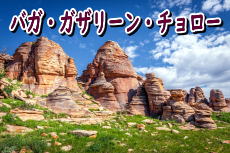
Baga Gazriin Chuluu (small land stones) is located about 37 km northwest of Delgertsogt District in the province. This granite area, surrounded by flat plains, lies at 1,768 m above sea level and covers 300 square kilometers. Around the mountain paths and valleys, besides many springs, a considerable number of ancient tombs, kirigsuurs, rock paintings and monuments can be seen. There are many sightseeing spots, such as Ger Chuluu, Suduntiin Am, Jargalant cave, the Eye Spring, and the poplar rocky gorge called Takhiriin Khavtsal. Ger Chuluu has many cave drawings, including a petroglyph depicting a man tying two ibex with a rope. These cave paintings belong to the late Bronze Age and attract attention from researchers.

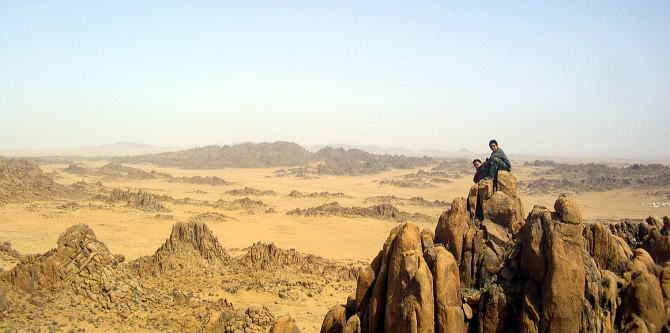
A filming location. Ikh Gazriin Chuluu is a complex rocky cliff of broken rock made of granite, porphyry and diorite, with origins in the Permian and Cretaceous periods. Located at 1,565–1,709 m above sea level, it covers 600 square kilometers, 30 km long and 15 km wide. It has more than 40 caves, and the cave called Tagtanii Baast (pigeon droppings) is 30 m long, 3.5 m wide and 10 m high. The place is home to more than 20 animals, including marmots, foxes, black insects, hawks and corsac foxes. It was designated a nature reserve in 2003 and protected as a national park in 2012. Here is a monument dedicated to the national elder singer N. Norovbanzad and her popular song "Uyakhan Zambuu Tiviin Naran." In addition, the first open-air theater named after the great singer was established at Ikh Gazriin Chuluu.


Ongi Monastery is in Saikhan-Ovoo District of the province. The two temples on the north and south sides of the Ongi River together are called Ongi Monastery. It is considered one of the largest monasteries in Mongolia. Ongi Monastery was built in 1660. At the time its grounds were huge, with about 30 temples and four large prayer halls. About 1,000 monks are said to have lived there. In the socialist era Ongi Monastery was treated as taboo, and in 1939 it was completely destroyed. Many monks were victims of the great purge. After democratization, several monks returned to the monastery and began giving Buddhist talks. At present, one prayer hall has been completely rebuilt. Traces of the temples still remain around the monastery. The Ongi ruins lie about 18 km south of Saikhan-Ovoo village.


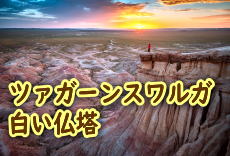
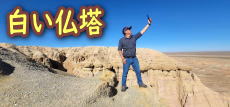
A filming location. The "Tsagaan Suvarga(white stupa)" slope is located southwest of Mount Deel in Ulziit District. It is a steep slope, an ancient seabed, characterized by sediment structures formed over millions of years. The slope faces east toward the sun and is interesting because from afar it looks like the ruins of an ancient city. This landscape exceeds 60 m at its highest point and continues for an impressive 400 m. The stupas rise to the sky at a 90-degree angle. After heavy rain, the torrent flowing below the stupas looks like a huge waterfall.

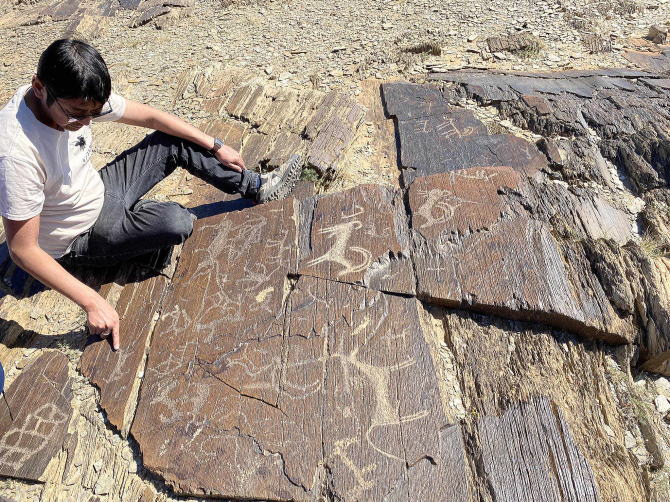
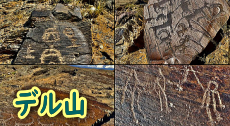
Rock paintings of Mount Deel: Mount Deel extends 25 km from the white stupa and lies within the territory of Ulziit District. From the base at the bottom to the summit, the east face of the mountain is covered with animals of various kinds, humans, symbols and emblems carved in different historical periods. Images of animals such as ibex, horses, riders, camels and anthropomorphic figures are the most common. Mount Deel has more than 3,000 rock paintings, and four inscriptions in classical Runic script, Mongolian and Chinese date back to the Tang dynasty, and about 20 square tombs are said to remain. Countless rock paintings drawn by ancient people are scattered about.
Figures of the people who handle them are also drawn, so you can imagine how people lived long ago.


Khukh Burd Lake is in Adaatsag District of the province. There were once said to be three rivers flowing into this lake, but two dried up in intermittent droughts. The one remaining river is also gradually losing water level over time.
The castle ruins are 7–8 m high, 10 m wide and 25 m long. The castle consists of four parts surrounded by walls 150 cm thick. Around the 16th century, a Tibetan nobleman built a temple for the Mongols but had to return home without finishing the construction. The work is said to have ended without a ceiling. So it was named "Oloigui Sum" (temple without a ceiling). A ceiling was later made, but all of it was destroyed by a thunderstorm. Even now it has no roof.
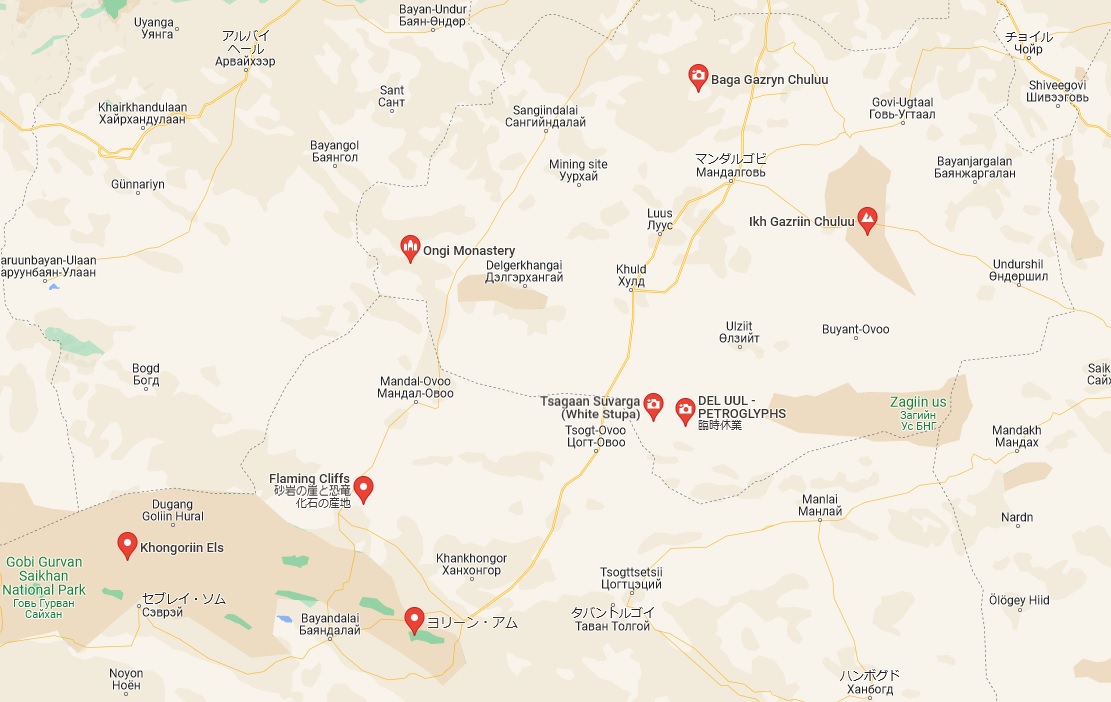
Map of the Central Gobi

Filming Location Gobi Desert: Central Gobi Tour
MO-1027 Central Gobi sightseeing, White Stupa, Ikh Gazriin Chuluu, 2 days with 1 night in a ger
▶ Book this tour
|
Central Gobi, Mount Deel and Baga Gazriin Chuluu, 2-Day / 1-Night Course With guide |
||||
   |
Day 1 |
Hotel pickup at 7 am, then by private car toTsagaan Suvarga (white stupa), about 5–6 hours. Enjoy the road across the steppe. "This place name translates literally as 'white stupa,' a sightseeing area with a naturally formed stupa shape." It is an area (filming location) that has recently become popular with tourists. Even an hour is not enough for photography. In the afternoon, by private car tothe rock paintings of Mount Deel. Countless rock paintings drawn by ancient people are scattered about, and figures of the people who handle them are also drawn, so you can imagine how people lived long ago. |
||
|
Day 2 |
Morning: to Baga Gazriin Chuluu (small land rocks), a filming location. In the granite area, strange rocks, rock paintings, ancient tombs and springs are scattered. Then visit a nomad's ger and a camel riding experience. In the afternoon, head to Ulaanbaatar. The tour ends on arrival at a city hotel around 18:00. |
|||
|
Meals |
Breakfast: ○ |
Lunch: yes. Dinner: yes |
Dinner: ○ |
|
|
Course code: MO-1027 |
1 person $640 |
2 people $505 |
3 people $405 |
|
|
*The above itinerary and times may change locally depending on weather and traffic congestion on the day. In that case, please follow the instructions of the local staff. We appreciate your understanding. |
||||

Course code: VV-1023:This Year's Best Tour!
South Gobi Desert with Round-Trip Private Car, 5-Day / 4-Night Ger Tour
|
South Gobi Desert by Car, Khongor Sand Dunes and White Stupa, 5-Day / 4-Night Course |
||||
  |
Day 1 |
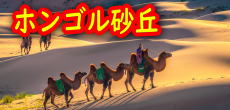
At 7:00 the local English-speaking staff meet you. Enjoy the car trip across the steppe, about 7 hours. In the afternoon, after arriving in the Gobi Desert, sightseeing while horse riding inthe Yolyn Am valleyand the Gobi Nature Museum. Yolyn Am means "Valley of the Eagles" in Mongolian. After arriving at the tourist ger at Yolyn Am, free time. At night enjoy stargazing. With luck you may see shooting stars. |
||
  |
Day 2 |
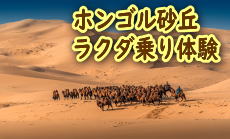
Morning: head to the Khongor Sand Dunes, the largest and most spectacular dunes in MongoliaKhongor Sand Dunes(200 km), about 4–5 hours. The dunes are known as the "singing sands," rising 800 m above the plain and stretching about 180 km. The spectacular dunes are surrounded by lush vegetation fed by a small river called the Khongor. "Stay in a tourist ger" |
||
 |
Day 3 |
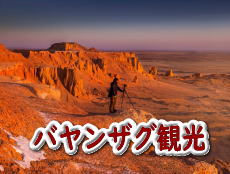
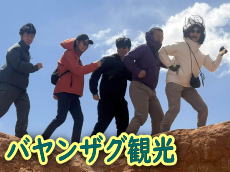
After breakfast, to Bayanzag (140 km). This is where the American explorer Andrews first discovered dinosaur eggs and a large number of fossils in 1922 (filming location). Visit the Bayanzag museum and watch a video on the history of Bayanzag. Bayanzag sightseeing takes about 1–2 hours. Then free time. |
||
  |
Day 4 |
|
||
 |
Day 5 | Morning: to Baga Gazriin Chuluu (small land rocks), a filming location. In the granite area, strange rocks, rock paintings, ancient tombs and springs are scattered. Then visit a nomad's ger. Head to Ulaanbaatar. The tour ends on arrival at a city hotel. | ||
|
Meals |
Breakfast: 4 |
Lunch: 5 |
Dinner: 4 |
|
|
Course code: VV-1023 |
1 person $1,745 |
2 people $1,475 |
3 people $1,340 |
|
|
*The above itinerary and times may change locally depending on weather and traffic congestion on the day. In that case, please follow the instructions of the local staff. We appreciate your understanding. |
||||
* Prices, times, number of services and opening hours shown are guidelines. They may change, so please ask us for the latest information.
Detailed Guide to Mandalgovi (Dundgovi Province)
| Location | Capital of Dundgovi Province |
|---|---|
| Distance from Ulaanbaatar | About 270 km south |
| Founding of the province | Established in 1942, separated from parts of Tuv and Umnugovi provinces |
| Notable people | The politician Chagdarjav, the urtiin duu singer Norovbanzad, morin khuur players and others |
Overview of the town
Mandalgovi is the central city of Dundgovi Province, about 270 km south of Ulaanbaatar. Dundgovi Province was created in 1942 by taking parts from Tuv and Umnugovi provinces.
The town is known as the hometown of the politician Chagdarjav. He was appointed finance minister when the Bogd Khan government was formed in 1911, and an equestrian statue stands in front of the provincial office. It has also produced many cultural figures, such as Norovbanzad, called the "greatest diva of the 20th century," an actor who plays the morin khuur, morin khuur players, and a person who devoted effort to running the cultural center.
Getting around and highlights
East of the provincial office (equestrian statue) is the Dundgovi Provincial Museum. The provincial main street extending south from there is lined with shops, shopping malls and canteens. Near the south end of the street are shops dealing in local specialties, where you can buy salted Gobi wild onions (khumul) and Gobi wild herb tea.
Directly north of the provincial office is a park with what is said to be one of Mongolia's largest morin khuur monuments and a statue of Jonon Khar. Jonon Khar is the winged horse that appears in the legend of the origin of the morin khuur. In Mongolia there is a custom of placing important things to the north, which conveys how much this town values the morin khuur.
Dundgovi Provincial Museum (Дундговь аймгийн музей)
A museum established in 1949, a clue to knowing the region. Archaeological materials, ores and folk materials are clearly displayed. Especially precious are the accessories of the Khalkha Mongols and an old zoosonshiree (a cord-weaving tool). On religion, the materials on the high monk Zava Damdin (1867–1936) are rich, and you can learn the footsteps of the master who was active in the early 20th century.
Hotels and camps
| Burd (Burd Restaurant & Hotel) | Mid-range. 18 rooms in all. On the main street, so convenient. Attached restaurant (Mongolian food, pasta, pizza, etc.), sauna and shopping center. Single about 70,000–80,000, twin about 110,000–140,000 tugrik (breakfast included). |
|---|---|
| Ongiin Khiid Ger Bowdar | A family-run tourist camp near Ongi Monastery. Open all year. Has a restaurant. About 40,000 tugrik per person (breakfast extra). No electrical outlets in the gers. |
| Secret of Ongi | A high-class tourist camp in a desert oasis. 45 gers. Open only from May to mid-October. Restaurant, sauna, massage, laundry and more are well provided. A standard ger is about 150,000 tugrik per person (three meals included). |
Highlights nearby
To nearby highlights, charter a car in Mandalgovi. The charter fee for a jeep is about 280,000 tugrik per day as a guide.
Ikh Gazriin Chuluu (Их газрын чулуу)
One of Mongolia's largest granite areas. Rocks of many sizes and shapes pile on one another, creating mysterious scenery. It was designated a nature reserve in 2003. Besides wildlife such as ibex (wild goats), argali (large wild sheep) and gazelles, depending on the season you can also see nests and chicks of cinereous vultures, buzzards and kites in the rocks. You can also stay at a nearby tourist camp. Nearby are an open-air theater and a monument praising Norovbanzad. The sunrise and sunset seen from the rocks are superb.
| Location | About 80 km northeast of Mandalgovi |
|---|---|
| How to get there | Charter a jeep (about 280,000 tugrik per day) |
Baga Gazriin Chuluu (Бага газрын чулуу)
An area of connected granite rock hills with springs and scattered ruins such as old tombs and rock paintings. The rock painting of the Ger Chuluu, depicting people hunting two ibex, is said to date to the Bronze Age. At the bottom of a hole about 50 cm deep that looks man-made is a spring called the "Eye Spring," and its water, applied to the eyes, is believed to cure illness.
| Location | About 70 km northwest of Mandalgovi |
|---|---|
| How to get there | Charter a jeep |
Ongiin Khiid (Онгийн хийд)
Ruins of a Buddhist monastery on the banks of the Ongi River. Built from 1760 to 1810, at its peak more than 1,000 monks lived in its 28 halls. One of the great temples representing the Khalkha region, together with the surrounding temples it was called the "Three Temples of Ongi." It was completely destroyed in 1939, and more than 200 monks lost their lives or were imprisoned. After the collapse of socialism, a ger museum was built in 2001 to gather Buddhist items, and in 2004 one of the temples was rebuilt.
| Location | About 230 km southwest of Mandalgovi |
|---|---|
| How to get there | Charter a jeep |
| Ongi River | A river about 435 km long that rises in Uvurkhangai Province and flows into the Gobi |
Tsagaan Suvarga (Цагаан суварга)
A landform created by eroded sandstone. It got its name because from afar it looks like a "white (tsagaan) stupa (suvarga)." Cliffs about 60 m high and more than 400 m long continue, like a castle wall.
| Location | About 160 km south of Mandalgovi |
|---|---|
| How to get there | Charter a jeep |
Uush Mankhan (Өөш манхан)
Dunes that have been used since long ago for heat treatment of kidney disease. A clinic was built in 1978. The treatment season is limited, but a doctor instructs how long and how often to bury yourself in the sand according to your symptoms. In summer daytime the dunes get so hot you could be burned.
| Location | About 70 km east of the center of Ulziit District (about 100 km south of Mandalgovi) |
|---|---|
| How to get there | Charter a jeep (about 280,000 tugrik per day round trip) |
Morin Tolgoin Tsav (Морин толгойн цав)
A sandstone landform meaning "horse head cliff." There is a legend about topaz. Long ago, a man found a topaz as large as a horse, and many nobles began to fight to seize it. With the help of a beautiful girl the man hid the stone, but both lost their lives in the fighting. This is said to be where the stone was hidden. It is said that as long as the topaz is here, people can live happily.
| Location | About 120 km east of the center of Ulziit District (about 130 km south of Mandalgovi) |
|---|---|
| How to get there | Charter a jeep |
Course code: VV-1022: Fly there, return by car, Central Gobi and South Gobi Desert, 3-Night Ger Tour
 |
Day 1 |
Morning (by arrangement): the English-speaking staff meet you at your local hotel. Move to Chinggis Khaan International Airport. Enjoy the domestic flight departing at 13:30. |
||
  |
Day 2 |
Morning: head to theKhongor Great Sand Dunes, Mongolia's highest.Yolyn Am220 km from, about 4–5 hours. After arriving, check in at the tourist camp, rest, and thenKhongor Great Sand Dunessightseeing. These great dunes are 800 m high and 3.5 km wide, boasting the highest in Mongolia. Enjoy the moving desert scenery.Try camel riding to the Khongor Sand Dunes. If you wish, you can enjoy the sunset or sunrise from the Khongor Sand Dunes. At night, a sky full of stars! "Stay in a tourist ger" |
||
 |
Day 3 |
After breakfast, to Bayanzag (140 km). This is where the American explorer Andrews first discovered dinosaur eggs and a large number of fossils in 1922 (filming location). Visit the Bayanzag museum and watch a video on the history of Bayanzag. Bayanzag sightseeing takes about 1–2 hours. Then move to the tourist camp.At night, a sky full of stars! |
||
 |
Day 4 | After breakfast, by private car toTsagaan Suvarga (white stupa). "This place name translates literally as 'white stupa,' a sightseeing area with a naturally formed stupa shape." It is an area (filming location) that has recently become popular with tourists. Even1an hour is not enough for photography. In the afternoon, by private carthe rock paintings of Mount Deel. Countless rock paintings drawn by ancient people are scattered about, and figures of the people who handle them are also drawn, so you can imagine how people lived long ago. Then move to the tourist camp.At night enjoy a sky full of stars. The scenery is wonderful, so photography is possible. "Stay in a tourist ger" |
||
 |
Day 5 | Morning: to Baga Gazriin Chuluu (small land rocks), a filming location. In the granite area, strange rocks, rock paintings, ancient tombs and springs are scattered. Then visit a nomad's ger. Head to Ulaanbaatar. The tour ends on arrival at a city hotel. | ||
|
Meals |
Breakfast: 4 |
Lunch: 4 |
Dinner: 4 |
|
|
Course code: VV-1022 |
1 person $1,880 |
2 people $1,680 |
3 people $1,410 |
|
|
*The above itinerary and times may change locally depending on weather and traffic congestion on the day. In that case, please follow the instructions of the local staff. We appreciate your understanding. |
||||


[Obon Holiday, 7 Nights / 8 Days]<Fuel surcharge included> [MIAT Mongolian Airlines] Vivant Filming Locations Tour, Gobi Desert and Khongor Sand Dunes, 8 Days
Khongor Sand Dunes, Bayanzag and Yolyn Am sightseeing by domestic flight. On the return by private car, visit the White Stupa, the Large Land Rocks, Terelj National Park and more.
Central Mongolia (Central Gobi and Eastern Gobi) 4WD Safari Tour, 8 Days
A 4WD safari tour seeing Ikh Gazriin Chuluu, Tsagaan Suvarga (white stupa) and the World Energy Center
Sand Dunes, Horse Riding at Ar Burd on the Steppe and Nomad Ger Stay, 6 Days
150 km southwest of Ulaanbaatar. Beyond the vast steppe, majestic dunes suddenly spread out. Enjoy the beauty of the steppe and the fresh scent of its grass that can be tasted only in Mongolia.
6-Day Tour of the Filming Locations in the Mongolian Desert
Khongor Sand Dunes, Bayanzag and Yolyn Am sightseeing by domestic flight. On the return by private car, the Central Gobi Desert tour:visit Tsagaan Suvarga (white stupa) and Baga Gazriin Chuluu (small land rocks).
Gobi Desert, Mongolia: Visit the Filming Locations, Camel and Horse Riding Experience, 8-Day Tour
By plane to the Khongor Sand Dunes, Bayanzag and Yolyn Am sightseeing. By car, the Central Gobi Desert tour and a stay at the Steppe Nomads Camp on the steppe:Tsagaan Suvarga (white stupa) and Baga Gazriin Chuluu (small land rocks)2511.jpg)
Naadam Festival, Gobi Desert, Bayanzag and Central Gobi Sightseeing, 8 Days
3 nights in a city hotel, 4 nights in a ger. After watching Mongolia's biggest event, the Naadam festival, an 8-day tour by domestic flight to the Gobi Desert, Khongor Sand Dunes, Yolyn Am valley, Bayanzag and the wonderful scenery of the Central Gobi
Mongolian Gobi Desert, Khongor Sand Dunes and Orkhon Valley Tour, 10 Days
Baga Gazriin Chuluu, Yolyn Am valley, Khongor Sand Dunes, Ongi Monastery, Karakorum ruins and the Burd steppe. The best tour around Mongolia. 2 nights in a city hotel, 1 night in a nomad homestay, 6 nights in a ger camp.
Mongolian Gobi Desert, Central Gobi and Safari Tour by 4WD, 8 Days
A 4WD safari tour seeing the Yolyn Am valley, Khongor Sand Dunes, Bayanzag, Ongi Monastery, Karakorum ruins and the Burd steppe.
Make a Wish at the Mother Rock Eej Khad, Horse Trekking, 8 Days
A round-trip horse trekking journey to Eej Khad, the rock said to grant wishes. One private vehicle and a cook travel with you, so you can feel secure. A horse riding tour for intermediate and advanced riders.



Basic Mongolia Information
Basic information

Tourist Destinations in Mongolia
Destination
Travel Guide
Travel guide
Winter Tours
Winter tours
Tailor-Made Travel
Tailor-made
Tourist Events
Tour events
Tourist Camps
Tourist camps
Ulaanbaatar Sightseeing
UlaanbaatarCity Tour

Mongolian Food
Mongolian Foods
Restaurant Guide
Restaurants
Gallery
Gallery
Car Rental
Car Rental
FAQ
FAQ