Mongolia tours with free WiFi during your trip – leave it to a local specialist travel company.

Contact us for advice and quotes on local Mongolia toursEmail:info@nomadmongolia.com

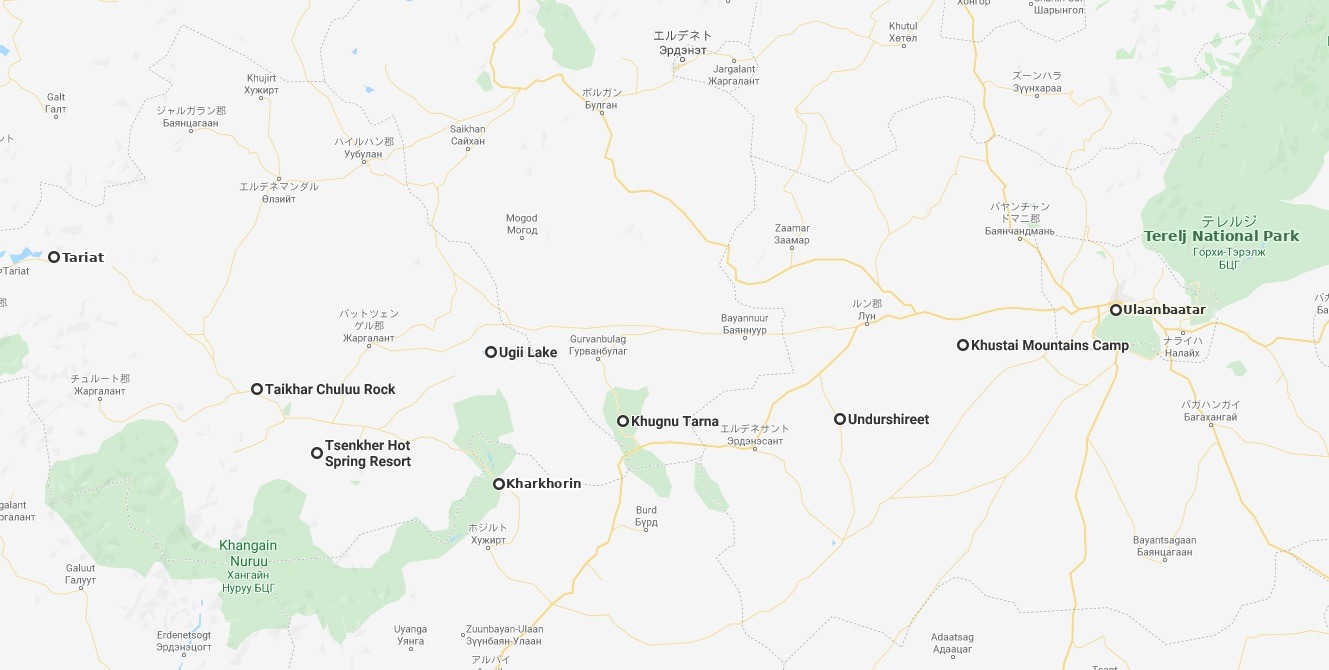
Central Mongolia Sightseeing



The calm beauty of the wide expanses of Central Mongolia mixes with a variety of landscapes including dunes and rocky mountains.

Cultural Landscape of the Orkhon Valley
The Orkhon Valley is a valley spreading along both banks of the Orkhon River in central Mongolia, about 360 km west of Ulaanbaatar, the capital of Mongolia. Its cultural landscape was inscribed as a UNESCO World Heritage Site as an illustration of the nomadic traditions cultivated over more than 2,000 years.
For centuries the Orkhon Valley has been regarded as the seat of the kings of the steppe. It appears in history through the "Orkhon inscriptions" set up in this valley by the Turkic Bilge Khagan in the 8th century. The mountains forming the valley were held sacred as the axis of the world in Tengri worship, and Mount Otuken in particular was regarded as special. The Orkhon Valley holds the Orkhon inscriptions, the Khar Balgas ruins, the ruins of Chinggis Khaan's capital Karakorum, Erdene Zuu Monastery and more.

World Heritage Karakorum Ruins
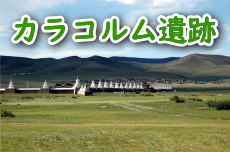
In the cultural landscape area known as the Orkhon Valley in central Mongolia, many ruins and historic sites remain, and the most famous is the Karakorum ruins. When the Mongol and Turkic nomads who have long lived in Mongolia founded their states, they chose the Orkhon River basin for their capitals. Chinggis Khaan also ordered the capital of the Mongol Empire to be established there. By his order, the city of Karakorum was built in 1235, and it is famous for having been, for a time, the center of the world. Erdene Zuu of the Karakorum ruins is one of Mongolia's World Heritage Sites. Suddenly appearing in the steppe, the ruins consist of 108 striking white stupas and outer walls surrounding the Buddhist temple, a group of monasteries with a long history in Mongolia. A little walk from the ruins is Turtle Rock, and the site where the "Karakorum History Museum" was built by a joint project of the Mongolian Cabinet and JICA with Japanese ODA.
Erdene Zuu Monastery
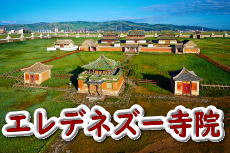
Erdene Zuu Monastery is the first Buddhist monastery, founded in 1586 by Abtai Khan using materials from the then Karakorum empire. It is an invitation from the flow of history of the old capital of the Mongol Empire. It has been protected as a special state-protected site since 1944. Each of the four sides of Erdene Zuu is a wall 420 m long, with 25 stupas on each side and two at each corner, 108 stupas in all. It now works as a museum. UNESCO designated Erdene Zuu and the ruins of the city of Karakorum a World Cultural Heritage Site in 1996. While viewing Karakorum, visitors can also visit the Ulaan Tsutgalan waterfall, the 45–70 degree hot springs of Mogoit, Elsen Tasarkhai, Ovgon Khiid and more.
Beautiful Burd
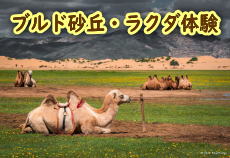
In this area, only Burd has sand dunes. The fine-grained dunes are drawn with beautiful wind ripples. Locally called Elsen Tasarkhai (a detached stretch of sand), the beautiful contrast of steppe and dunes is also a popular travel scene.

Mount Khugnu Khan near Burd
Mount Khugnu Khan has been a national special protected area since 1997. Mount Khugnu Khan in Gurvanbulag village, Bulgan Province, is 1,962 m above sea level. On Mount Khugnu Khan there are deer, wild boar, wolves, roe deer and other animals, and forests of birch and larch. This camp, 280 km west of Ulaanbaatar near Burd, lies in a very quiet environment with a dazzling blue sky and white clouds and nothing around except Mount Khugnu Khan rising behind. This is a real nomad homestay. Horse riding on the steppe is also possible. There are two Buddhist temples on Mount Khugnu Khan.

Khoshoo Tsaidam Ruins
The Khoshoo Tsaidam Museum, one of the highlights of the World Heritage "Orkhon Valley Cultural Landscape," lies about 40 km northeast of Kharkhorin on the east bank of the Orkhon River. Built midway between the mausoleums of Bilge Khan and Kul Tegin of the 8th century Second Turkic Khaganate, it displays materials centered on the original famous Bilge Khan inscription and Kul Tegin inscription, also called the Orkhon inscriptions. The museum was built on the basis of the joint Mongolian-Turkish excavation survey of 2000–2003. Inside the museum are displayed the originals of the Kul Tegin stele and the stele of his elder brother Bilge Khan.

Orkhon Waterfall "Red Waterfall"
About 2–3 hours by car west of Burd, in a quiet place, flows the Orkhon River, which feeds Lake Baikal. Among its sights, the "Orkhon Red Waterfall," 10 m wide and about 24 m high, looks small to Japanese eyes, but is a rare sight in this steppe land. The Orkhon Waterfall lies in the upper reaches of the Orkhon River, flowing from the Khangai Mountains of Uvurkhangai Province, Mongolia.
The Orkhon Waterfall is called the red flow. It was formed by volcanic eruption about 20,000 years ago and is part of the World Heritage property. When the water volume is rich, beautiful scenery spreads out, including the force of the falls. When the water is low, the falls may disappear altogether. The natural waterfall can be called the form of the earth itself.

Tuvkhun Monastery, a Buddhist Temple Built on a Rocky Mountain
Tuvkhun Monastery stands on the summit of Mount Shireet, about 20 km northeast of Batulzii village in Arkhangai Province, Mongolia, and is a temple inscribed as a World Cultural Heritage Site. 450 km west of Ulaanbaatar, you can see the horse rope, footprints and sunbathing seat used by Zanabazar himself, and a rocky mountain of unique natural form called Ekhiin Umai (womb), where you can even crawl through a gap in the rock. For Mongolians this place has meaning equal to the divine land of Gandhara, and they have respected and protected it. A suitable place for alpine plant observation and nature research; you ride a horse from the trailhead to the monastery.

Tsenkher Hot Springs
The capital of Arkhangai Province, about 11 hours overland west of Ulaanbaatar. Further in are natural hot springs. Called the hidden bath of Ogedei Khan, an open-air bath in the steppe. It has been chosen as one of the world's 100 hot springs.
Its source is 86°C, a natural steppe hot spring flowing directly from a rich source. It is even chosen among the world's 100 hot springs. A must-see place in Central Mongolia for hot spring lovers.
It takes 8 hours by car from Ulaanbaatar. The accommodation is a cluster of tourist gers. It is an ideal place to relax in the hot springs while looking at Mongolia's beautiful wooded mountains and steppe.

Ugii Lake
Ugii Lake is a beautiful lake between steppe and mountains in central Mongolia, located west of Ulaanbaatar and northwest of Karakorum.

Terkhiin Tsagaan Lake
Terkhiin Tsagaan Lake (Great White Lake) is located in Terkhiin Tsagaan Lake National Park in Arkhangai Province, 590 km west of Ulaanbaatar.

Khorgiin Togoo Volcano
Khorgiin Togoo ("hidden cauldron") is an extinct volcano in central Mongolia. It lies near the village of Tariat in Arkhangai Province, north of the Suman River. Thousands of years ago the lava of this volcano flowed toward the lake, covered the lakeshore and flowed further into the lake, and still pokes its head above the lake surface. You can see a crater 200 m in diameter and 100 m deep, surrounded by a lava field. Khorgiin Togoo (altitude 2,240 m). This extinct volcano was designated a nature reserve in 1965. The area around the volcano, hardened by lava bubbles, has interesting scenery. Climbing the mountain there also gives magnificent views right before your eyes.

Taikhar Rock
The name "Taikhar" comes from Mongolian mythology. In the myth, this rock is said not to have formed by itself. The rock stands 22 km west of the provincial capital Tsetserleg, along the main road, in the middle of an empty steppe. There is nothing like it around the rock, and it is visible right away from the main road. Inscriptions dating back to the Turkic era are written on Taikhar Rock.
Taikhar Rock is about 26 m high. Symbols and animals have been carved on it since around 6000. Scripts carved include Tibetan, Old Mongolian, Khitan, Uyghur, Manchu, Chinese and Runic, and historical figures from the Turkic era onward are mentioned.

Undurshiret Steppe
Undurshiret is located 200 km southwest of Ulaanbaatar, midway to Karakorum, and is a campsite boasting the best location on the banks of the Tuul River flowing across the steppe.
Its beauty is clear from having been chosen as a filming location for director Makoto Shiina's film "White Horse" and a Kubota commercial. This campsite has special permission from Undurshiret village, so there is no other campsite around. With no other facilities, town lights or power lines, it is also ideal for viewing a sky full of stars!
Hot air balloon flight: become the wind blowing across the Mongolian steppe and enjoy the moving 360-degree panorama. Horse riding experience is also possible.

Undurdov Steppe
The surroundings are steppe as far as the eye can see, very wide and quiet. Though close to the capital Ulaanbaatar, you do not feel it at all. This is south of Ulaanbaatar,
The stars in the night sky are more wonderful than anything you have experienced. With no light near the ger, the whole sky is covered in stars. You can hike through the strictly protected national park and explore the ruins of Manzushir Monastery.

Central Mongolia Sightseeing and Optional Tours
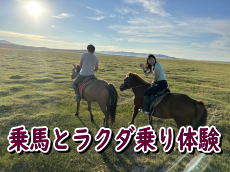
MO-1028 Semi-Gobi, Burd on the steppe, horse and camel riding, 2 days with 1 night in a ger
▶ Book this tour
|
Burd Dunes Sightseeing, Horse Riding on the Steppe and Camel Trekking, 2 Days / 1 Night Course With guide |
||||
   |
Day 1 |
Hotel pickup early at 8 am. On the way, we stop to enjoy a snack and coffee or tea while looking at beautiful scenery.Semi-Gobi DesertAfter arriving at (the Burd dunes), visit the ger of a local nomad and be introduced to nomad culture. Enjoy sightseeing the dunes on a camel for 1 hour. Then a lunch of traditional Mongolian food is served. In the afternoon, horse riding experience on the steppe. Safe even for beginners (1–2 hours). Accommodation is as the traveler wishes. If you wish, you can enjoy the sunset or sunrise from the Burd dunes. At night, a sky full of stars! |
||
|
Day 2 |
Breakfast at the ger camp at 9 am. Relax until departure. At 10 am head toward Ulaanbaatar. On the way,Hustai National Reservesightseeing. We go to see the "takhi," said to be the world's last wild horses. |
|||
|
Meals |
Breakfast: ○ |
Lunch: yes. Dinner: yes |
Dinner: ○ |
|
|
Course code: MO-1028 |
1 person $555 |
2 people $470 |
3 people $405 |
|
|
* The above prices are for a nomad ger stay; for a tourist camp stay add $65. * Based on this itinerary, it is also possible to changefor an extra charge to adeluxe gerwith toilet and shower.. |
||||

MO-1017 World Heritage Karakorum sightseeing, Burd on the steppe, 2 days with 1 night in a ger
▶ Book this tour
|
Old Capital Karakorum Sightseeing and Camel Trekking on the Burd Steppe, 2 Days / 1 Night Course With guide |
||||
   |
Day 1 |
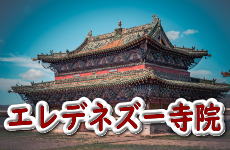
Depart your hotel in Ulaanbaatar at 8:00 am in the morning. By car toold capital Karakorum. On the way, enjoy ice cream at the Harumafuji Milk Farm. The road runs across a vast steppe as far as the eye can see. A steppe drive enjoying nature. Visit a nomad ger and enjoy meeting local people. After lunch, move to Karakorum city. After arrival, free time. Enjoy the natural celestial show (it may not be visible depending on the weather). "Stay at a ger camp" |
||
|
Day 2 |
Breakfast at the ger camp at 8 am. Relax until departure. Move to the Karakorum ruins, the old capital of the Mongol Empire built by the second emperor, Ogedei Khan. On the site of the capital that once became the center of the world, there still standsErdene Zuu Monasterysurrounded by 108 stupas. See also the granite Turtle Rock. After visiting the Karakorum Museum, return to Ulaanbaatar by private car. Camel riding experience on the way. After arriving in Ulaanbaatar, to your hotel. The tour ends. |
|||
|
Meals |
Breakfast: ○ |
Lunch: yes. Dinner: yes |
Dinner: ○ |
|
|
Course code: MO-1017 |
1 person $590 |
2 people $505 |
3 people $405 |
|
|
*The above itinerary and times may change locally depending on weather and traffic congestion on the day. In that case, please follow the instructions of the local staff. We appreciate your understanding. |
||||
▶ Book this tour
|
Old Capital Karakorum Sightseeing and Horse Trekking in Burd National Park3 Days / 2 Nights Course, with guide |
||||
 |
Day 1 |
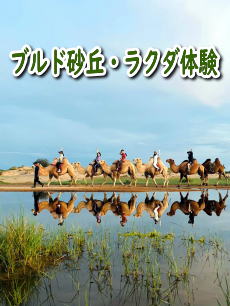
Depart a main hotel in Ulaanbaatar at 8:00 am in the morning. By car to the steppe,Burd, the gateway to the old capital Karakorum. On the way, enjoy ice cream at the Harumafuji Milk Farm. About 4 hours. Lunch time on the steppe on the way. The road runs across a vast steppe as far as the eye can see. A steppe drive enjoying nature. The tourist camp is a "ger tourist camp" with dunes spreading right before your eyes, called Elsen Tasarkhai (a detached stretch of sand), in splendid contrast to the steppe. After arrival, visit a nomad ger and enjoy meeting local people. After dinner, enjoy the natural celestial show (it may not be visible depending on the weather). |
||
   |
Day 2 |
Breakfast at the ger camp at 8 am. Relax until departure. Hiking to the dunes is also possible. Move to theold capital Karakorum ruinsof the Mongol Empire built by the second emperor, Ogedei Khan, about 1 hour. On the site of the capital that once became the center of the world, there still stands Erdene Zuu Monastery surrounded by 108 stupas. See also the granite Turtle Rock. Then return to Burd on the steppe by private car. In the afternoon, receive a riding lesson (explanation) from a nomad (instructor) along with the horses. Then horse trekking starts from the tourist camp as a base. The guide and nomads accompany you. Then camel riding experience at the Burd dunes. "Stay at a ger camp" |
||
|
Day 3 |
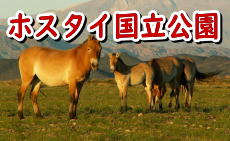
After breakfast, head to Ulaanbaatar at 9 am. On the way,Hustai NationalReserve sightseeing. We go to see the "takhi," said to be the world's last wild horses. |
|||
|
Meals |
Breakfast: yes. Lunch: yes |
Lunch: yes. Dinner: yes |
Dinner: yes |
|
|
Course code: MO-1015 |
1 person $805 |
2 people $640 |
3 people $535 |
|
|
* As options, shooting at targets with a gun, ATV (buggy) andMotorbikerental (250cc) are available. Extra charges apply. |
||||
MO-1024: Nomad Homestay in the Vast Burd of Mongolia, 3 Days / 2 Nights in a Ger
▶ Book this tour
|
Nomad Homestay on the Mongolian Steppe, Unlimited Horse Riding, Open to Beginner Riders! |
||||
  |
Day 1 |
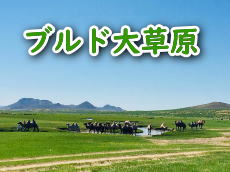
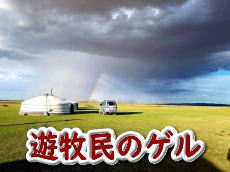
In the morning at 9:00, the English-speaking guide meets you at your local hotel. Move to the ger of a nomad living on the steppe,Burd. On the way, enjoy ice cream at the Harumafuji Milk Farm. Enjoy the car journey, about 4 hours. |
||
   |
Day 2 |
After breakfast, to the old capital of the Mongol Empire built by the second emperor, Ogedei Khan,Karakorum Ruinsabout 1 hour. On the site of the capital that once became the center of the world, there still stands, surrounded by 108 stupas,Erdene Zuu Monastery. See also the granite Turtle Rock. Then return by private car to the nomad ger on the Burd steppe. |
||
|
Day 3 |
After breakfast, head to Ulaanbaatar at 9 am. On the way,Hustai National Reservesightseeing. We go to see the "takhi," said to be the world's last wild horses. |
|||
|
Meals |
Breakfast: yes. Lunch: yes |
Lunch: yes. Dinner: yes |
Dinner: yes |
|
|
Course code: MO-1024 |
1 person $740 |
2 people $605 |
3 people $535 |
|
|
* Shooting at targets with a gun is available as an option. An extra charge applies. |
||||
▶ Book this tour
|
Stay at Tsenkher: Natural Hot Springs and Horse Trekking, 3 Days / 2 Nights Course |
||||
 |
Day 1 |
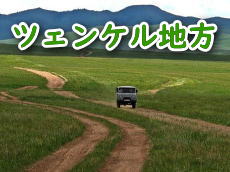
At 7 am, by private car to the steppe,Tsenkher Hot Springs, about 5–6 hours. Enjoy ice cream at the Harumafuji Milk Farm. On the way, move to the old capital of the Mongol Empire built by the second emperor, Ogedei Khan,old capital Karakorum ruins. On the site of the capital that once became the center of the world, there still stands, surrounded by 108 stupas,Erdene Zuu Monastery. See also the granite Turtle Rock. After visiting the Karakorum Museum, head to Tsenkher by private car. After arrival, free time. Enjoy the hot springs that well up on the steppe. |
||
|
|
Day 2 |
After breakfast, horse trekking on the steppe with the nomads from the camp as a base. On the way, visit a nomad's ger. Enjoy the nomads' handmade cheese and, depending on the season, airag (fermented mare's milk). |
||
|
Day 3 |
After breakfast, head to Ulaanbaatar at 9 am, about 5–6 hours. Camel riding experience on the way. After arriving at a main hotel in Ulaanbaatar, thank you for your hard work. |
|||
|
Meals |
Breakfast: yes. Lunch: yes |
Lunch: yes. Dinner: yes |
Dinner: yes |
|
|
Course code: MO-1026 |
1 person $870 |
2 people $670 |
3 people $605 |
|
|
*The above itinerary and times may change locally depending on weather and traffic congestion on the day. In that case, please follow the instructions of the local staff. We appreciate your understanding. |
||||


* Prices, times, number of services and opening hours shown are guidelines. They may change, so please ask us for the latest information.
Detailed Guide to Tsetserleg
| Location | Capital of Arkhangai Province. About 450 km west of Ulaanbaatar |
|---|---|
| Features | Spreads at the southern foot of Bulgan Mountain (a nature reserve). Dairy farming is thriving |
| Bus | Long-distance buses leave Ulaanbaatar several times a week. About 9 hours 45 minutes; fares are subject to change. |
Arkhangai Province lies north of the Khangai Mountains and has thriving dairy farming. "Beautiful Arkhangai in the north" is a saying, and it is known as one of the most beautiful places in the country. Old temples centered on the temple founded by the first Zaya Gegeen, a Khalkha reincarnate lama, still dot the area and show a calm atmosphere. For travelers it also serves as a relay point on the way west to Terkhiin Tsagaan Lake and south to Tsenkher hot springs.
Getting Around Tsetserleg
The main street runs straight southeast from Bulgan Mountain. Banks, the post office, shops and restaurants are gathered along it. The town itself is compact and can be covered on foot. The long-distance bus terminal is a little away from the town center.
| Post office | 9:00–18:00, closed Saturdays, Sundays and holidays. Internet can be used inside the post office (900 Tg/hour) |
|---|
Arkhangai Provincial Museum (Архангай аймгийн музей)
A temple that once housed the high priest Zaya Gegeen. It was founded in 1684 by the first Zaya Gegeen, a Khalkha reincarnate lama, and is now a temple and museum housing relics and writings of successive Zaya Gegeens; the stupa in the grounds holds the mummy of the first. In the center of the courtyard stands the 245 cm high Bugut inscription. It was found in 1957 in the upper Tamir River basin and restored standing on a tortoise base. Inscriptions in Sogdian language and script are carved on the front and both sides. The back is in Brahmi script, and decipherment is progressing earnestly.
| Opening | Until 19:00. Opening hours change by season (it may close in winter) |
|---|---|
| Admission | 5,000 Tg, photography 15,000 Tg |
Bulgan Mountain (Булган уул)
A mountain with a view over the whole town of Tsetserleg. It is a rocky mountain rising at the back of the Arkhangai Provincial Museum, once Zaya Gegeen's temple, on the north side of Tsetserleg town. The whole area is designated a nature reserve. The rock face on the south slope is exposed and is said to have 13 Buddhist paintings. Halfway up the southeast slope stands a large Buddha, as if watching over the town. From there you can see all of Tsetserleg. On the steps up to the halfway point, carved zodiac animals stand one by one.
Taikhar Rock (Тайхар чулуу)
A huge rock obo standing in the steppe. A huge rock about 22 km northwest of Tsetserleg, about 70 m around and about 25 m high. On the surface of the rock you can see ink writing, originally from ancient times, in Runic, Uyghur, Mongolian, Manchu, Tibetan and other scripts. Chinese ink writing was later found too. Cyrillic graffiti has now been newly added. There is an obo on top of the rock.
| How to get there | About 22 km northwest of Tsetserleg town. About 30 minutes by car |
|---|
Tsenkher Hot Springs (Цэнхэрийн рашаан)
A tourist camp with open-air baths, about 28 km southeast of Tsetserleg, 1 hour 30 minutes by car. Said to be Ogedei Khan's hidden bath, the hot spring has white steam rising from its source. The water temperature stays at 86.5°C. Soaking in an open-air hot spring surrounded by gentle steppe and Arkhangai forest relieves the fatigue of travel. Swimwear is basically worn when bathing. Bathing only costs roughly 30,000 Tg.
| How to get there | There is no bus service; charter a car from Tsetserleg. About 1 hour 30 minutes. Depending on weather (rising rivers), via Tsenkher it can be about 50 km and the time can double. Negotiate in front of the long-distance bus terminal or the zakh (market). About 90,000 Tg one way. |
|---|
Terkhiin Tsagaan Lake (White Lake)
| Location | Tariat District, Arkhangai Province |
|---|---|
| Type and size | Freshwater lake. About 16 km long, maximum depth about 20 m |
| Origin | Formed when a river was dammed by lava |
| Inflow and outflow | More than 10 rivers from the Khangai Mountains flow in, and the Suman River flows out of the lake |
| Protection | Designated a nature reserve together with nearby volcanoes |
| How to get there | There is no bus service; charter a car. From Tsetserleg about 3 hours, 100,000–120,000 Tg one way. It is common to join a tour and stay at a tourist camp around the lake. |
Gentle steppe spreads around it, where you can enjoy horse riding and camping. Famed as a scenic tourist spot, it draws many visitors from Mongolia and abroad. The birth of the lake has a story handed down locally.
The story of how the lake was born (summary)
Long ago there was no lake here, only a beautiful pasture. In the middle was a well, and an old couple lived drawing water from it every day. The rule was to always cover the well after drawing water, but one day the old woman forgot. That night water overflowed from the well, flooding and nearly swallowing the world. Then a strong man named Bukhmandal appeared on the summit of Mount Ulaanmandal, cut off the mountaintop and threw it onto the mouth of the well, blocking it perfectly. The water that had overflowed remained as the lake, the story goes.
Khorgiin Togoo (Khorgo Volcano) (Хоргын тогоо)
The remains of a huge crater are impressive. A dormant volcano that erupted more than 9,000 years ago and has been inactive since. Altitude 2,240 m. The lava field formed by the eruption spreads over about 20 km, and the lava layer extends 40–50 m underground. The crater slope is about 50 degrees, about 100 m deep, with a crater diameter of 300–400 m. From the parking lot it takes 15–30 minutes to climb to a place where the crater is visible. About 20 km from here are also three dormant volcanoes. Diamonds have also been found near the Khorgo volcano.
| Location | About 180 km north of Tsetserleg |
|---|
Chuluut Gorge (Чулуутын хавцал)
A gorge created by the eruption of the Khorgo volcano. A deep gorge carved by the Chuluut River, extending about 100 km. The Chuluut River has its source at Mount Gurvan Angarkhai in the Khangai Mountains. The cliffs are 40–60 m high. It lies on the way from Tsetserleg to Terkhiin Tsagaan Lake.
| Location | About 120 km northwest of Tsetserleg |
|---|
Accommodation
There are tourist camps around the lake. For example, Surtiin Tulga Camp is inside Terkhiin Tsagaan in Tariat District, with several grocery stores nearby, which is convenient.
Naadam Festival, Karakorum Ruins and Tsenkher Hot Springs, 8-Day Tour
3 nights in a city hotel and 4 nights in a ger, watching a Naadam festival event on the steppe. You can also see Erdene Zuu Monastery surrounded by white walls, Turtle Rock, the Karakorum Museum, Tsenkher hot springs, and ride horses on the steppe.
Karakorum Ruins, Khorgo Volcano and Lake Khuvsgul, 8-Day Tour
After visiting the Karakorum ruins and the Khorgo volcano, go to Lake Khovsgol, called the "Switzerland of Mongolia," Mongolia's largest freshwater lake near the Russian border. On the lakeshore live the Tsaatan people, who keep reindeer.
Mongolian Gobi Desert, Khongor Sand Dunes and Orkhon Valley Tour, 10 Days
Baga Gazriin Chuluu, Yolyn Am valley, Khongor Sand Dunes, Ongi Monastery, Karakorum ruins and the Burd steppe. The best tour around Mongolia. 2 nights in a city hotel, 1 night in a nomad homestay, 6 nights in a ger camp.
Horse Riding, Karakorum Ruins, Mongolian Ger Stay and Nomad Experience, 5 Days
World Heritage Karakorum ruins, the steppe and the beautiful dunes of Burd, a nomad homestay, a horse riding experience and a camel riding experience. The best course for getting to know Mongolia.
2 Nights in Ulaanbaatar, 2 Nights in Burd, Karakorum Ruins and Horse Riding, 5 Days
World Heritage Karakorum ruins, the steppe and the beautiful dunes of Burd, a horse riding experience and a camel riding experience in Burd. A local guide shows you around. The best course for getting to know Mongolia.
World Heritage Karakorum Ruins, 1 Night in Orkhon Valley, 1 Night in Burd, 5 Days
World Heritage Karakorum ruins, the steppe and the beautiful dunes of Burd, a horse riding experience and a camel riding experience in Burd. A 5-day tour with horse and camel riding, seeing Karakorum and the Orkhon Valley.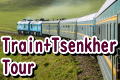
Eastern Gobi Sainshand, Karakorum Heritage and Tsenkher Hot Springs, 8 Days
East Gobi by train, a fossil digging experience and the meditation places of ancient lamas, Karakorum heritage and Erdene Zuu Monastery. Free plan at Tsenkher hot springs. A ger stay and horse riding experience are also included.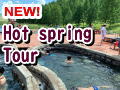
Karakorum Ruins, Tsenkher Hot Springs and Undurshireet, 8 Days
Mongolia's top course. 1 night in a nomad ger on the Undurshiret steppe, World Heritage Karakorum sightseeing and a soak in the natural Tsenkher hot springs. The hot springs are deeply satisfying. 2 nights of horse trekking in beautiful Burd, and Hustai National Park, an 8-day course
Central Province: Assemble a Portable Ger and Go Horse Trekking, 8-Day Course
You can join even alone. Enjoy horse trekking on the Mongolian steppe and work together to assemble a ger. An English-speaking guide and a skilled cook accompany you. You ride 20–30 km a day. Beginners can join too.
Central Mongolia Tour: Orkhon Valley, Natural Hot Springs and Ugii Lake, 8 Days
An adventure tour racing across Mongolia's great nature by jeep. See World Heritage Karakorum, Ugii Lake, Taikhar Rock, Terkhiin Tsagaan Lake, the Undurshiret steppe, Hustai National Park and more.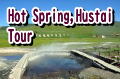
Hot Springs on the Mongolian Steppe! World Heritage Karakorum and Hustai National Park
World Heritage Karakorum and a hot spring trip at the same time! Ride across the steppe and see the World Heritage Karakorum ruins and Erdene Zuu Monastery. A ger camp stay at Tsenkher hot springs, a horse riding experience, and the wild takhi horses at Hustai.
Khongor Sand Dunes, Horse and Camel Riding, World Heritage Karakorum, 8 Days
Using domestic flights and staying in a ger, enjoy camel and horse riding to your heart's content while looking at the beautiful nature of the South Gobi. See World Heritage Karakorum, Erdene Zuu Monastery and the Burd steppe.
Mongolian Gobi Desert, Central Gobi and Safari Tour by 4WD, 8 Days
A 4WD safari tour seeing the Yolyn Am valley, Khongor Sand Dunes, Bayanzag, Ongi Monastery, Karakorum ruins and the Burd steppe.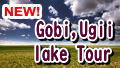
Ugii Lake, Tsenkher Hot Springs, Orkhon Valley and Gobi Desert, 10-Day Tour
After seeing Ugii Lake, Tsenkher hot springs, Karakorum ruins, Ongi Monastery, Bayanzag, Khongor Sand Dunes and the Yolyn Am valley, return to Ulaanbaatar by plane. 2 nights in a city hotel, 8 nights in a ger camp
Mongolian Gobi Desert, Orkhon Valley, Tsenkher Hot Springs and Ugii Lake, 11 Days
A tour going around Baga Gazriin Chuluu, Yolyn Am valley, Khongor Sand Dunes, Bayanzag, Ongi Monastery, Karakorum ruins, Tsenkher hot springs and Ugii Lake. 2 nights in a city hotel, 8 nights in a ger camp
Golden Eagle Festival and World Heritage Karakorum, 9 Days
Departing 9/28: Karakorum Ruins and the Golden Eagle Festival Tour in Mongolia's Westernmost Province. The Kazakhs living in Bayan-Ulgii Province are famous for hunting with golden eagles.
Bird Watching and Wild Bird Photography Tour on the Mongolian Steppe, 8 Days
Travel from the taiga to the steppe and enjoy bird watching that differs by environment, guided by Mongolian experts with broad knowledge of the birds of Mongolia.
Bird Watching and Wild Bird Photography Tour on the Mongolian Steppe, 11 Days
Mongolia can be called one of the meccas of bird watching in East Asia. In cooperation with the Mongolian Ornithological Society (NGO), we arrange a specialist bird guide. An English-speaking guide accompanies you throughout.
Head for the Eight Lakes, Horse Trekking and Bubble Tent Tour, 8 Days
Ride across the steppe with the wind. Travel on horseback to the eight lakes where Mongolia's best starry sky can be seen. See Naiman Nuur and the Karakorum ruins. An 8-day tour with tent stays. One private vehicle and a cook travel with you, so you can feel secure.
8-Day Tour Riding Off-Road Motorbikes across the Mongolian Steppe
We use high-class bikes such as the KTM and the Yamaha Serow 250. A tour enjoying bikes with a hot air balloon on the Undurshiret steppe, the Karakorum ruins, Terkhiin Tsagaan Lake, Ugii Lake and the Burd dunes.



Basic Mongolia Information
Basic information

Tourist Destinations in Mongolia
Destination
Travel Guide
Travel guide
Winter Tours
Winter tours
Tailor-Made Travel
Tailor-made
Tourist Events
Tour events
Tourist Camps
Tourist camps
Ulaanbaatar Sightseeing
UlaanbaatarCity Tour

Mongolian Food
Mongolian Foods
Restaurant Guide
Restaurants
Gallery
Gallery
Car Rental
Car Rental
FAQ
FAQ