Mongolia tours with free WiFi during your trip – leave it to a local specialist travel company.

Contact us for advice and quotes on local Mongolia toursEmail:info@nomadmongolia.com


| Official name | Mongolia (Mongolia; Монгол) |
| Capital | Ulaanbaatar |
| Area | 1,566,500 km² |
| Total population | 3.45 million (2022 statistics) |

Mongolia has a land area of 2,392 km from east to west and 1,259 km from north to south, about four times the size of Japan. It borders Russia to the north and China to the south. Steppe is widespread from the center to the east, the south and west are desert, and the north is forest. In the west the Mongolian Altai mountain range extends, with peaks of 3,000 m and 4,000 m. It has no sea coast, but it is a country rich in nature with mountains, lakes, rivers and grand steppe.

A continental climate, and dry. In summer there are many days above 30 degrees. However, it is not unusual for it to turn suddenly cold and snow. In summer the sun sets late and it stays light until about 22:00. In winter it can be minus 20 to 30 degrees, so warm clothing is essential. Because it is dry, static electricity is terrible. From October it suddenly gets cold, and the cold continues until about April of the next year. Precipitation is low throughout the year.
Mongolia Weather Information


The official language is Mongolian. It is written in the Cyrillic alphabet (the Russian alphabet). The Kazakhs of Bayan-Ulgii in the west use the Kazakh language.
About 90% of the people are Khalkh, with more than 40 minorities including Kazakhs and Buryats.

The time difference from Japan is minus 1 hour in Ulaanbaatar. Only the three western provinces (Bayan-Ulgii, Khovd, Uvs) have a further minus 1 hour from Ulaanbaatar.


|
№ |
Provinces (Aimag) |
* Distance |
№ |
Provinces (Aimag) |
* Distance |
|
1 |
1709
km |
12 |
Selenge Province |
321
km |
|
|
2 |
Uvs Province |
1417
km |
13 |
Darkhan-Uul Province |
223
km |
|
3 |
Khovd Province |
1487
km |
14 |
43
km |
|
|
4 |
Zavkhan Province |
1023
km |
15 |
260
km |
|
|
5 |
Govi-Altai Province |
1037
km |
16 |
575
km |
|
|
6 |
779
km |
17 |
Govisumber Province |
223
km |
|
|
7 |
477
km |
18 |
450
km |
||
|
8 |
639
km |
19 |
338
km |
||
|
9 |
336
km |
20 |
Sukhbaatar Province |
565
km |
|
|
10 |
Orkhon Province |
373
km |
21 |
639
km |
|
|
11 |
431
km |
※UlaanbaatarDistance from |
|||

Rich in underground resources, the mining industry is thriving, followed by livestock herding of sheep, goats and so on. Exports are mostly mineral resources and cashmere products. Most goods are imported, and products from China, Russia, Korea, Japan and elsewhere stand out. Mongolia has also been hit hard by the global recession, and real estate and stock prices are sluggish. It receives support from donor countries including the International Monetary Fund (IMF) and Japan. It has relied on China for imports of agricultural products, but recently more companies are starting domestic production using the vast land, and agriculture is becoming a major industry. In 1206 Chinggis Khaan, who unified the several tribes on the Mongolian plateau and became Khan, founded the Mongol Empire. He built up the great Mongol Empire that spread as far as Europe. However, the Mongol Empire later declined, and from around the 16th century it came under the rule of the Qing dynasty. On December 1, 1911, the Mongolian people declared independence from more than 200 years of Qing rule and established an absolute-monarchy state. However, China and Tsarist Russia concluded a secret agreement between the two countries, and at the Kyakhta conference in May 1915 declared Mongolia an autonomous state under Chinese suzerainty, and in 1919 Chinese warlords abolished the autonomy of Outer Mongolia and occupied Mongolia.
In March 1921 the revolutionary movement against feudalism and colonialism rose, and the Mongolian Provisional People's Government and People's Army were created. The Mongolian revolutionary army, led by Sukhbaatar, joined the Soviet Red Army that arrived at the request of the provisional government. They cleared out the Chinese warlords and Soviet White Army occupying Mongolia, and on July 11, 1921, declared the establishment of the people's government. After that, following the Soviet socialist era, in 1992 with the collapse of socialism that occurred in Eastern Europe, it switched to capitalist policies and became the State of Mongolia, continuing to this day.

|
January 1 |
New Year |
|
Mid-February |
Tsagaan Sar. Lunar New Year. Three days from this day are holidays. Unlike China, the date of the Lunar New Year changes every year. |
|
March 8 |
Women's Day |
|
June 1 |
Children's Day |
|
July 11 |
Revolution Anniversary. Three days of the Naadam festival begin from this day. |
|
November 26 |
National Foundation Day |

Mongolia's currency is the tugrik (Tg). As of June 2025 the rate is 1 USD = 3,550 Tg.
11 denominations of banknotes are in circulation: 1 Tg, 5 Tg, 10 Tg, 20 Tg, 50 Tg, 100 Tg, 500 Tg, 1,000 Tg, 5,000 Tg, 10,000 Tg and 20,000 Tg (coins are not in circulation).


Currency exchange is possible at the airport, hotels, banks and exchange offices in the city. At hotels you can exchange at any time, but banks and exchange offices give a far better rate. Exchange offices are concentrated around the Flower Center and around the TEDY Center.
Many currencies can be exchanged, including the Japanese yen, US dollar, euro, Korean won, Chinese yuan and Russian ruble. Leftover tugrik can also be freely exchanged at exchange offices. Within the country tugrik are basically used, but many hotels, souvenir shops and ger camps accept payment in dollars. In the countryside there are few places to exchange money, so if you travel outside Ulaanbaatar we recommend exchanging into tugrik or dollars beforehand.

You can exchange money at a bank counter or withdraw cash from an ATM. Services such as VISA, MASTER, CIRRUS and PLUS can be used. With the cards above that you use in your home country, you can easily withdraw local currency at an ATM. ATMs are plentiful from Trade and Development Bank (TDB) and Golomt Bank, installed at bank branches and at hotels, department stores and supermarkets in the city. There have also been cases of pickpocketing after withdrawal, so take care in handling cash.

Taxis
Taxis are convenient for getting around the city. They fall into two kinds: taxis with a meter, and unofficial taxis.
Metered taxis can be safe too, but there are cases where, on seeing a foreigner, the driver runs the meter at an abnormal speed and charges an outrageous fare. The same applies to unofficial taxis; in such cases it seems wise to pay the amount charged without complaining. An unofficial taxi can be hailed by raising your hand at the roadside. Most are ordinary private cars. They have no fare meter, but check the distance on the odometer and calculate the fare.
As of November 2025, taxi fares are 1,000 to 1,500 tugrik per km. Recently the price of gasoline has not been stable, so this price is not necessarily correct. The key is to confirm before you get in. There are also conscientious drivers, but there are many cases of people trying to cheat foreigners out of money, so it is best to avoid riding alone as far as possible. There are also stories of the driver's acquaintance getting in partway through the ride, or of several people meeting somewhere and assaulting the passenger. Also, things left behind in a taxi never come back, so be careful.


Buses are the cheapest means of transport, with large buses and 14-seat minibuses called microbuses. The bus network connects provincial cities and villages.
Fares in the city are about 1,000 tugrik on a large bus.

International Phone Calls
International calls can be made from landline phones in hotels and elsewhere. Generally, many people use public phones with cheap international calling cards. There are several kinds, such as Mongol Telecom, MobiCom and Micom. Most have instructions written in Mongolian, so it is best to have an interpreter or guide teach you how to use them or help you.
Photo Phone Cards

For calls within Mongolia, public phones found throughout the city are also used. They work with cards in the same way as international calls. Phone cards are sold at post offices and convenience stores, and there is no card common to all phone companies. The safe choice is probably Mongol Telecom. There is also a more convenient phone called the "white phone". All over town, people in masks sit with a phone and cigarettes in a box. Local calls can be made from 100 to 150 tugrik per minute, paid in cash afterward. If you know the other party's contact number, a white phone is also handy.
Photo Tax Phones

As of January 2023, there are four mobile carriers in Mongolia. The largest is MobiCom. The others are Skytel, Unitel and G-Mobile. MobiCom also offers a mobile phone rental service. For long stays, we recommend buying a local SIM card and a cheap handset. With an international calling card for mobile phones, you can call Japan directly. Mobile phones can also be used if they support international roaming.

In major cities there are internet cafes everywhere, with signs reading "Internet". Most PCs run Windows XP or later and can be used in Japanese. The charge is 800 to 1,500 tugrik per hour. In Ulaanbaatar, the number of shops offering WiFi service is also increasing. Few hotels offer internet service other than upscale ones.

To send letters, postcards or parcels overseas, go to the Central Post Office, where it is easy. It is west of Sukhbaatar Square. A postcard is 880 tugrik. A letter up to 20 g is 1,100 tugrik; beyond that, 880 tugrik per additional 20 g. Registered mail is possible from 20 to 500 g, with 20 g at 2,800 tugrik; beyond that, 880 tugrik per additional 20 g. EMS (international express mail) is also handled. In addition, in Ulaanbaatar you can use international courier services such as DHL and UPS.
|
Ulaanbaatar Central Post Office Opening Hours |
||
|
Mail: Monday–Friday Saturday and Sunday |
7:30–21:00 9:00–20:00 |
|
|
Parcels: Monday–Friday Saturday and Sunday |
8:00–20:30 9:00–15:00 |
|

All car rental services in Mongolia come with a driver; you cannot rent just the vehicle. A Japanese international driving permit cannot be used. To use the service, you can arrange it through a specialist company, a travel agency or a hotel reception. The market rate is from 100,000 tugrik for a day's rental (fuel extra). A tour guide can also arrange a rental car suited to the purpose of your trip. Once your specific trip is decided, consulting your guide is another way.

Guide fees are $50–$70 per day for a tour guide. There are many newcomers just out of university, so it is better to check beforehand their language level and experience as a tour guide.
For business-specialist guides, from $100 per day. To secure an excellent guide matched to your specialty, it is better to request one in advance. Please ask a travel agency to arrange a guide.

Electricity in Mongolia is 220V, 50Hz. If you use 100V Japanese appliances, be sure to use a transformer. The main plug shape is two round holes. If you have a plug adapter that can be freely changed, there is no problem.

If you drink tap water at a hotel or elsewhere, it is better to boil it once. It is best to buy mineral water at supermarkets and convenience stores (delguur) in the city. There are several kinds, sold for around 1,000 tugrik per 500 ml.

Many toilets have no paper, so be sure to bring your own. Especially when going to the countryside, there are many places without even hand washing, and wet tissues are a necessity. There are pay toilets in the city, but they are few, so if you are in a hurry it is better to use a department store, supermarket or hotel.

Mongolian food is basically meat-centered. The meat is often mutton, and goat, beef, pork, chicken, horse and camel are also eaten. Typical dishes are buuz, said to be commonly eaten at New Year, something like steamed dumplings, and khuushuur, something like fried dumplings. Both contain mutton. Other common meals include piroshki, mantou, goulash and vegetable soup. They can be eaten at canteens called guanz, and buuz and khuushuur are very cheap at around 800 tugrik each. Mongolian traditional milk tea called suutei tsai also goes well with Mongolian food. It is lightly salted, but delicious once you get used to it. A dish served at celebrations and when hosting guests is khorkhog. Mutton, together with vegetables such as potatoes, onions and carrots, is steamed with heated stones. The meat itself is tender and delicious, but above all the vegetables and soup are superb. Dairy products are something you cannot forget in Mongolian food. Beginning with yogurt, there is plenty of fresh milk, cheese and more. These are best enjoyed at a nomad's home, but in town the products of the SUU company are the most popular. If you find them at a supermarket or elsewhere, please do try them. There is also much delicious ice cream made from fresh milk.
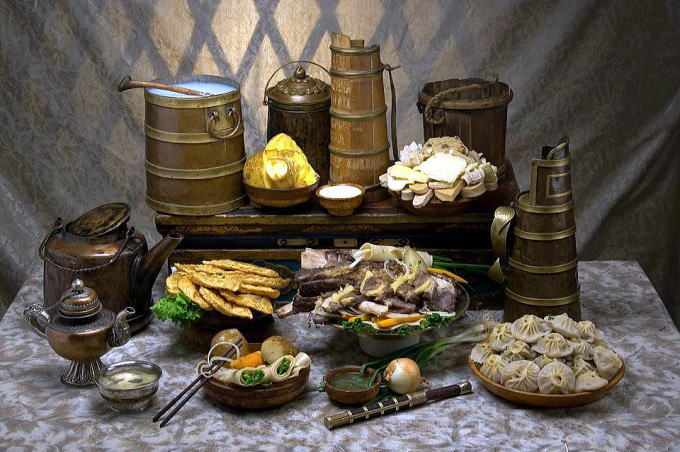

Ulaanbaatar has a great many restaurants and bars. You can enjoy cuisines of the world, starting with Japanese, as well as Korean, Chinese, Italian, Indian, Turkish and Russian. On the other hand, in provincial cities there are few restaurants other than Mongolian.
The Irish pub popular in Ulaanbaatar is full day and night all summer and is used by many tourists. It is well worth stopping by to feel Mongolia today.
There are also several Japanese restaurants. They are becoming more numerous, such as the "Sakura Bakery" often used by Japanese residents, "Sakura" at the Kempinski Hotel with a Japanese head chef, and the Japanese izakaya "Yorimichi". Mongolian restaurants are found everywhere, and there are many popular places liked by foreigners too, such as MODERN NOMADS.
At restaurants that serve foreigners, menus also carry English and English is understood, which is reassuring. Major cards such as VISA and Master can also be used. For details, please see the restaurant information in this magazine.

The most drunk in Mongolia is, after all, arkhi (Mongolian vodka). When many people gather, such as for business talks and celebrations, they almost always drink this arkhi. Mongolian vodka is around 40% alcohol. It is drunk straight in one go, so take care not to get drunk to the point of collapse.
Prices range from 8,000 tugrik for cheap ones to over 150,000 tugrik for expensive ones.
In summer, airag (fermented mare's milk) is also liked and often drunk. Like beer, it is enjoyed for how it goes down the throat. The airag you drink at a nomad's ger is fresh and especially good.
Beer is also often drunk. The brand Chinggis Beer is the country's representative local beer. It is smooth, light and easy to drink, and many people buy it home as a souvenir. In summer evenings, beer gardens enjoying draft beer on outdoor terraces can be seen all around the city and have become a feature of summer.
Recently popular is wine. There are many kinds, and if you go to a supermarket you can get delicious and cheap ones.

For shopping in Mongolia, the Narantuul Zakh (market) or the 3rd district are good. However, the zakh has many pickpockets, so much that even Mongolians avoid it, but as long as you are careful it is a tourist spot you should visit once. Most goods are imported from China and Russia, but there are many cheap things, which is fun. It is also good to get things you need during your trip here. There are riding boots and the Mongolian traditional costume, the deel, and you can also buy souvenirs.
The 3rd district is an area with many young people. Shops of famous brands have also appeared. Clothes, shoes, bags and so on are sold. Watch out for pickpockets here too. On the 2nd floor of the Bumbugur Zakh there is also a place selling a lot of clothes, which may be a surprising hidden gem.

When buying souvenirs, big department stores such as Nomin Department Store and the Sky Shopping Center are recommended. Both have a souvenir-only corner, which is convenient for shopping. Also recommended is Peace Avenue near Nomin Department Store, where many souvenir specialty shops stand in a row. The main types of souvenirs are felt products, cashmere products, folk crafts and original T-shirts, the traditional costume deel, and leather goods. Though bulky, the morin khuur (horse-head fiddle) is also one of the popular ones. For cashmere products, Gobi Cashmere and Altai Cashmere are famous. Both have factories in the city and sell directly. Being able to buy high-quality cashmere at a reasonable price is attractive. Camel wool products are also a souvenir older people appreciate. For felt products, Tsagaan Alt is recommended.
Near Nomin Department Store, stylish shops stir the urge to buy. The quality of the goods is high, and there is a wide selection of things that will please as souvenirs. For those with time, made-to-order products are also recommended. You can have original products to your own taste, such as leather jackets, shoes and deel, made in about 3 to 5 days. Among foods there are also popular souvenirs. Dried cheese made from dairy products, "byslag" and "aaruul", as well as pine nuts, smoked cheese, rock salt, chaga tea, airag and Mongolian vodka. Mongolian music played on the morin khuur is also popular, and CDs can be bought at souvenir shops and the record shop "HiFi".
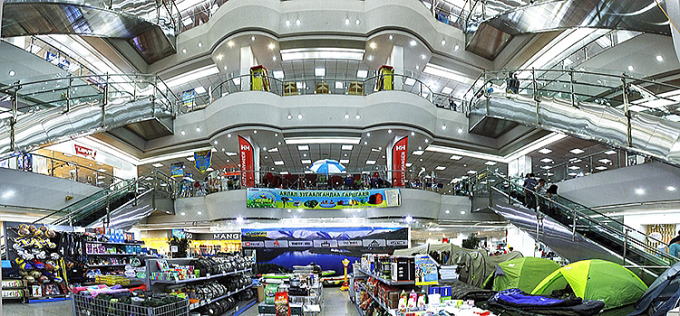

For Mongolians, discos and bars are popular entertainment. Discos are crowded with young people on weekends. Places that charge an entrance fee are somewhat more reassuring, while at free places fights frequently break out, so be careful. The entrance fee is 30,000 Tg per person. In any case, it is a place with many people and alcohol, so take full care. Bars also vary, from lively places with live music to places where you can drink slowly and calmly.
There are also a few strip bars. For massage there is a rich variety, from foot massage to body massage and Thai massage. There are also shops targeting Japanese people, so you can use them with peace of mind. Relax a body tired from the trip. For saunas, the Sunjin Sauna attached to the Sunjin Grand Hotel is well liked by Japanese residents. It is a complex where you can stay a long time, so if you have time, relax there.
There are many karaoke places. Japanese songs, except the most recent, are well covered, and you can enjoy them fully. There are also club-like places where women serve customers. For this kind of place we recommend going with someone who knows the area well.

Crimes such as pickpocketing and assault are frequently reported. There are many cases of being hassled after drinking, so be careful of your surroundings. For safety information, please see the information from this website'sEmbassy of Japan in Mongolia.

Summer gets quite hot and very dry. Watch out for heatstroke. Wear a hat and don't forget to stay hydrated. Medical facilities in Mongolia are not well developed, so it is better to prepare in advance, for example by taking out overseas travel insurance in case something happens. For medical information, please see this website'sEmbassy of Japan in Mongolia.



Basic Mongolia Information
Basic information

Tourist Destinations in Mongolia
Destination
Travel Guide
Travel guide
Winter Tours
Winter tours
Tailor-Made Travel
Tailor-made
Tourist Events
Tour events
Tourist Camps
Tourist camps
Ulaanbaatar Sightseeing
UlaanbaatarCity Tour

Mongolian Food
Mongolian Foods
Restaurant Guide
Restaurants
Gallery
Gallery
Car Rental
Car Rental
FAQ
FAQ